
Fayette Criminal Case Records
A Fayette County criminal court record is the court case file kept after the prosecutor files a charge. It is not the same as the sheriff's arrest or jail booking record. The court file tracks what was charged, how the defendant appeared, what motions or orders were filed, whether a plea or trial occurred, the disposition of each count, and what sentence or financial obligations were ordered. For a closer look at the charge list itself, use Fayette County arrest records and court charges. For the broader case universe, use Fayette County court records.
Adult criminal cases in Fayette County appear in the local trial-court system, with Fayette Circuit Court and Fayette Superior Court serving as the practical local courts. The official county materials place both courts at the courthouse in Connersville. The Fayette County Prosecutor, Bette Jones, handles state criminal prosecutions, while the Fayette County Clerk, Dawn Hughes, maintains local court records and copy access. Jail custody, release status, and booking questions are separate and route to the sheriff or jail; current custody research belongs with Fayette County inmate records.
The Fayette County Prosecutor page identifies the local office that handles state criminal prosecutions.
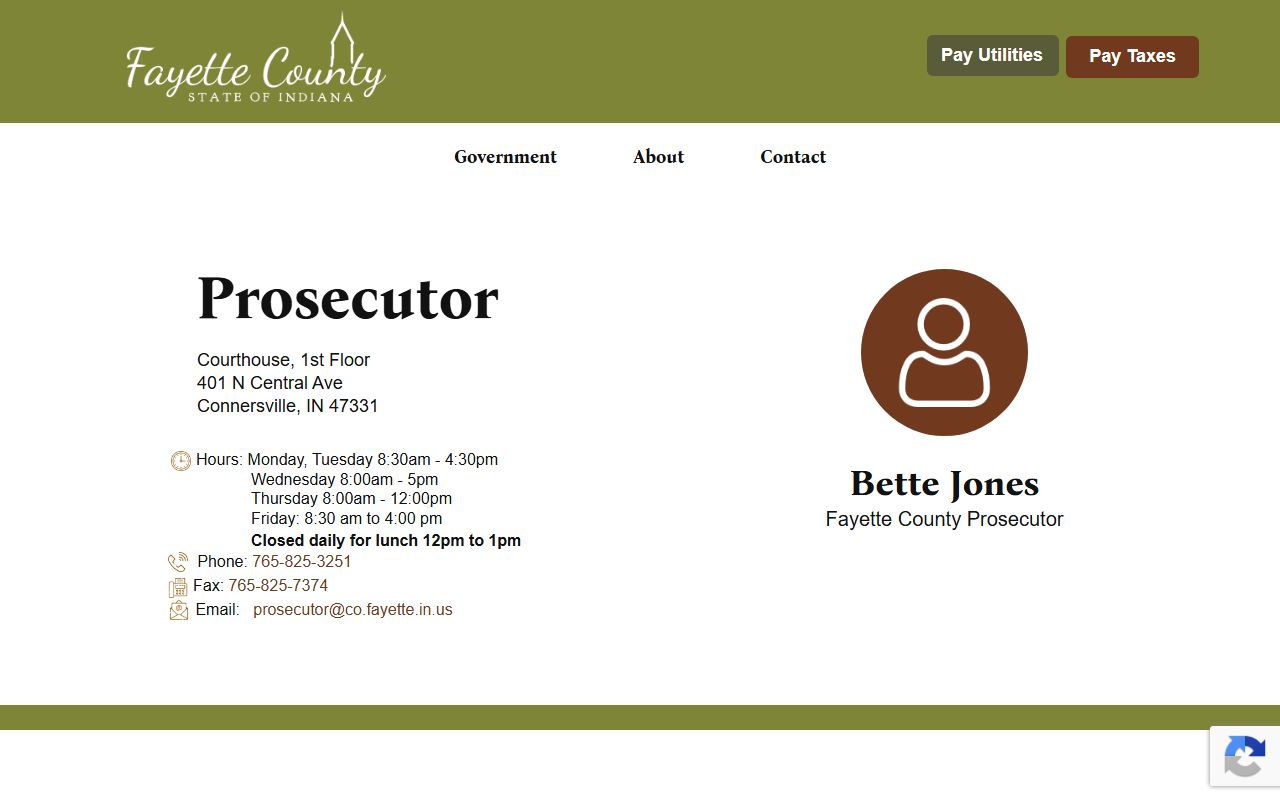
The prosecutor's role is important because the criminal court record begins with formal charges filed into the court system.
Search Fayette Criminal Cases
Fayette County criminal court records are searched through Indiana MyCase or the direct public case-search application at public.courts.in.gov/mycase. Search by defendant name when the cause number is unknown. Search by exact cause number when it is available. Use Fayette as the county filter and select criminal case types when the search interface allows it. Public case results may show charges, appearances, hearings, dispositions, sentencing entries, warrants, and financial balances.
- Open MyCase from the Indiana Judicial Branch Fayette County page or from the direct public search URL.
- Search by defendant last name and first name, or use the exact Indiana cause number.
- Narrow by Fayette County, court, criminal case type, and filing date when the result list is broad.
- Open the case result and read the chronological case summary, charges, hearings, pleas, dispositions, and sentence entries.
- Request certified copies from the Fayette County Clerk when MyCase does not provide the document or when an official copy is needed.
Statewide custody and offender tools serve different tasks. INjail and SAVIN can help with custody or notification checks, and Fayette County warrant records address active warrant questions. Those tools do not replace the criminal case file. A person can leave jail while the criminal court record remains open, and a case can remain searchable long after custody ends.
Fayette Criminal Case Flow
A Fayette County criminal court record grows as the case moves through court. The first entries may include the charging information, probable-cause material where public, bond terms, initial hearing, and appointment or appearance of counsel. Later entries may show pretrial conferences, motions, continuances, warrants, plea agreements, trial settings, sentencing, restitution, probation, and compliance reviews. Each stage creates docket entries, and some stages also create public documents.
Case flow: Charges Filed › Initial Hearing / Arraignment › Pretrial / Motions › Plea or Trial › Disposition › Sentencing
| Stage | What Happens |
|---|---|
| Charges Filed | The prosecutor files a criminal charge in Fayette Circuit Court or Fayette Superior Court, creating the court case record. |
| Initial Hearing / Arraignment | The defendant is advised of the charge, rights, bond, counsel issues, and future hearing dates. |
| Pretrial / Motions | Attorneys file appearances, discovery issues, motions, continuances, plea negotiations, and court orders. |
| Plea or Trial | The case resolves through a plea, dismissal, bench trial, jury trial, or other disposition. |
| Sentencing | The court enters jail, prison, probation, fines, costs, restitution, treatment, or other terms after conviction. |
Fayette Criminal Record Fields
A criminal court record in Fayette County can show both summary information and event-by-event docket history. The charge list is only part of the record. The court file may also include appearances by counsel, notices, bond orders, motions, plea agreements, judgments, sentencing orders, probation entries, payment obligations, and warrant events. Public MyCase document links may include some orders or judgments, but not all public documents are online.
| Field | What It Shows |
|---|---|
| Case Number | The Indiana cause number for the Fayette criminal case. |
| Defendant | The adult defendant name and role, subject to redaction or exclusion rules. |
| Court | Fayette Circuit Court or Fayette Superior Court. |
| Charges | Charge description, statute citation, level or class, filing date, plea, disposition, and sentence where entered. |
| Plea | The defendant's formal response or later plea agreement outcome. |
| Disposition | Whether each charge was convicted, dismissed, acquitted, amended, reduced, or otherwise resolved. |
| Sentence | Jail, prison, probation, fines, costs, restitution, treatment, or other court-ordered terms. |
| Chronological Case Summary | The docket history of filings, hearings, orders, warrants, notices, and payments. |
Charges vs. Convictions
A criminal charge is an accusation filed in court. A conviction is a case outcome after a guilty plea, verdict, or other judgment of conviction. Fayette County criminal court records may show charges that were later dismissed, reduced, amended, or resolved with no conviction. This distinction matters when reading MyCase results because the charge list can remain visible even when the final disposition is not a conviction.
| Charge | Conviction | |
|---|---|---|
| Stage | Accusation filed by the prosecutor | Final result after plea, verdict, or judgment |
| Proof Level | Based on filing standards and probable cause | Based on guilty plea or proof beyond a reasonable doubt |
| Record Effect | May appear even if later dismissed or reduced | Can trigger sentence, probation, fines, costs, and collateral effects |
| Where To Read | Charge list and early docket entries | Disposition, judgment, sentencing, and financial entries |
Read Dispositions and Sentences
Dispositions must be read charge by charge. One count can be dismissed while another results in a conviction. A plea agreement can reduce a charge or resolve several counts at once. A sentence entry can include jail, prison, probation, suspended time, restitution, fines, costs, treatment, no-contact terms, or compliance conditions. Payment entries may lag behind the actual balance, so financial questions should be confirmed with the clerk.
Indiana MyCase may display final orders and judgments in some criminal cases, but the official record comes from the court maintaining the record. For Fayette County, certified copies and official clerk confirmations route through the Fayette County Clerk. When a docket shows a warrant issued or withdrawn, custody status should still be checked through the sheriff, jail, INjail, or SAVIN, because docket timing and jail timing are not always the same.
The Indiana Prosecuting Attorneys Council Fayette prosecutor page is another official source identifying the local prosecutor contact.
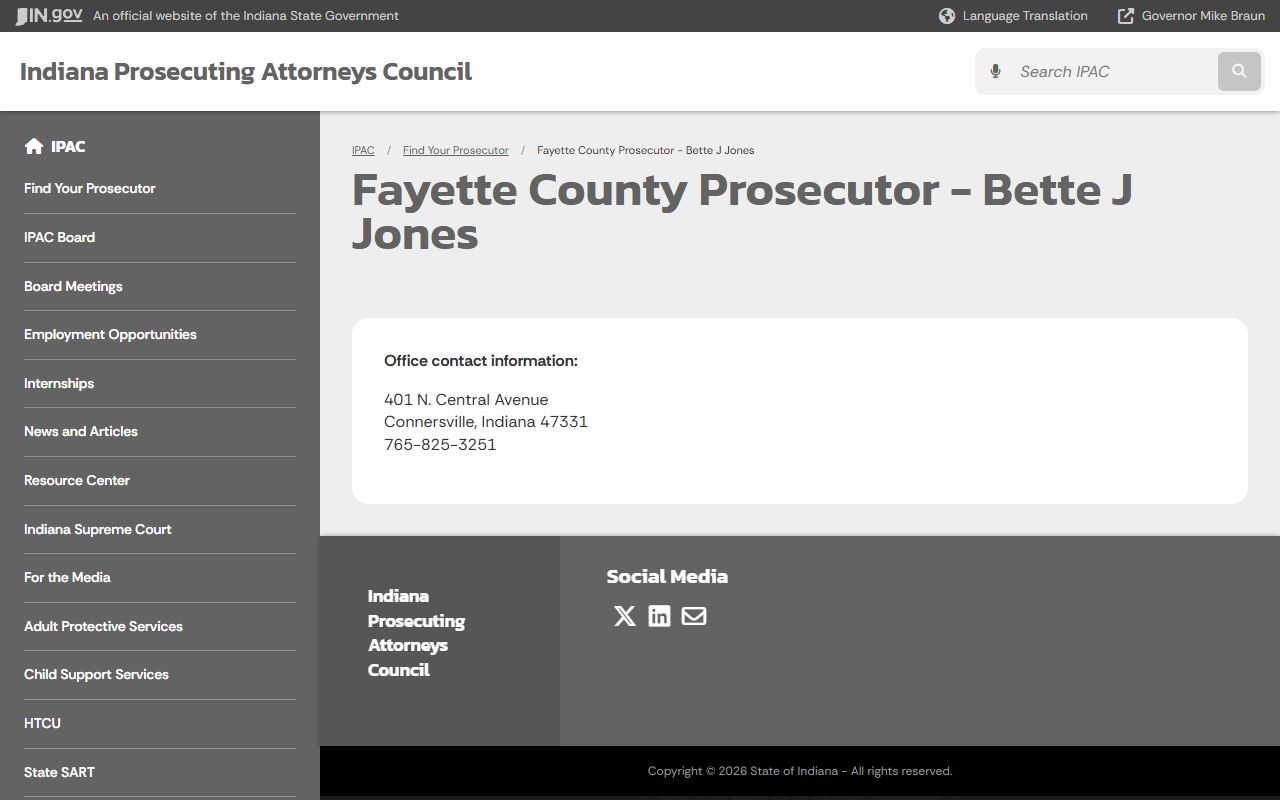
That prosecutor listing supports the local criminal-case path: law enforcement may arrest, but the prosecutor's filed charges become the court case.
Sealed vs. Expunged Records
Indiana criminal records can be sealed or expunged under Indiana Code Title 35, including the expungement chapter cited in the research as IC 35-38-9. The exact path depends on whether the record is arrest-only, dismissed, acquitted, misdemeanor, lower-level felony, more serious felony, or otherwise excluded. Waiting periods, sentence completion, payment obligations, pending charges, later convictions, and prosecutor consent can affect eligibility.
| Sealed | Expunged | |
|---|---|---|
| Public Visibility | Removed from general public access by law or court order. | Public access is limited after a granted expungement, with effects that vary by case type. |
| Record Holders | Court and agencies may retain restricted access. | The court sends orders to affected record holders after granting relief. |
| Law Enforcement | Access may remain for authorized purposes. | Some records remain available to law enforcement or by court order. |
| Fayette Filing Path | File through the court that handled the case when a petition or order is required. | File in Fayette Circuit/Superior via the clerk for Fayette County cases. |
Indiana Code Title 35 is the source for criminal law and expungement rules used in Fayette County criminal court records.
The statute source matters because expungement effects are not identical for every charge, conviction, or nonconviction record.
Public Access to Criminal Records
Adult Fayette County criminal court records are generally searched through MyCase unless a rule or order makes the record confidential, sealed, expunged, or redacted. Indiana's Access to Public Records Act supplies the general public-records framework. Indiana Administrative Rule 9 addresses court-record access at the courthouse and remote electronic access. Access to Court Records Rule 5 lists excluded information, and Access to Court Records Rule 9 gives a path to seek access to excluded records.
Key Statutes:
IC 5-14-3 - Indiana's general public-records law for public agencies.
IC 35-38-9 - Indiana's sealing and expungement framework for eligible criminal records.
IC 31-39-1 - Indiana juvenile court record access and confidentiality framework.
Criminal Background Checks
A casual MyCase lookup is not the same as a compliant employment, tenant, credit, insurance, or licensing background check. Criminal court records can be incomplete, delayed, sealed, expunged, corrected, or limited by public-access rules. A Fayette County criminal case result should be verified with the clerk before relying on a copy as official. Statewide criminal-history systems and consumer-reporting background checks follow different rules from a public court-record search.
Important: Public court lookups are not FCRA consumer reports and should not be used for regulated screening decisions.
Restricted Fayette Criminal Records
Restricted Fayette County criminal court records can include juvenile delinquency, CHINS, termination, adoption-related material, sealed cases, granted expungements, medical or mental-health records, protected-person data, financial identifiers, and other information excluded by rule. Protection order cases are not found through MyCase because protected-person identifying information is excluded from online public access. Pending or denied expungement cases may appear, while granted expungements may be removed or limited depending on the type of relief ordered.
The Indiana State Public Defender may be relevant for post-conviction matters, but it is not the county clerk and does not replace MyCase or local clerk records. Fayette County criminal court record requests for case documents, certified copies, and docket entries should start with MyCase and then move to the Fayette County Clerk if online access is incomplete.
The Indiana State Public Defender page is a statewide post-conviction resource, separate from local Fayette County criminal court record access.
That distinction helps keep record access, defense representation, post-conviction review, and clerk copy requests in their proper lanes.